Why Your Outfit Feels Tighter by 11pm - and How to Dress Around It

Quick Answer: Your body is measurably larger in the evening than in the early evening, for four reasons that stack: fluid pooling in the legs and feet from hours upright, sodium from restaurant food pulling water into tissue, normal digestive volume, and body temperature rising in a warm venue. Meanwhile the garment itself has often stretched, warmed, and relaxed at the seams while shrinking at the waistband.
Dress for eleven o’clock rather than seven, and the whole evening improves.
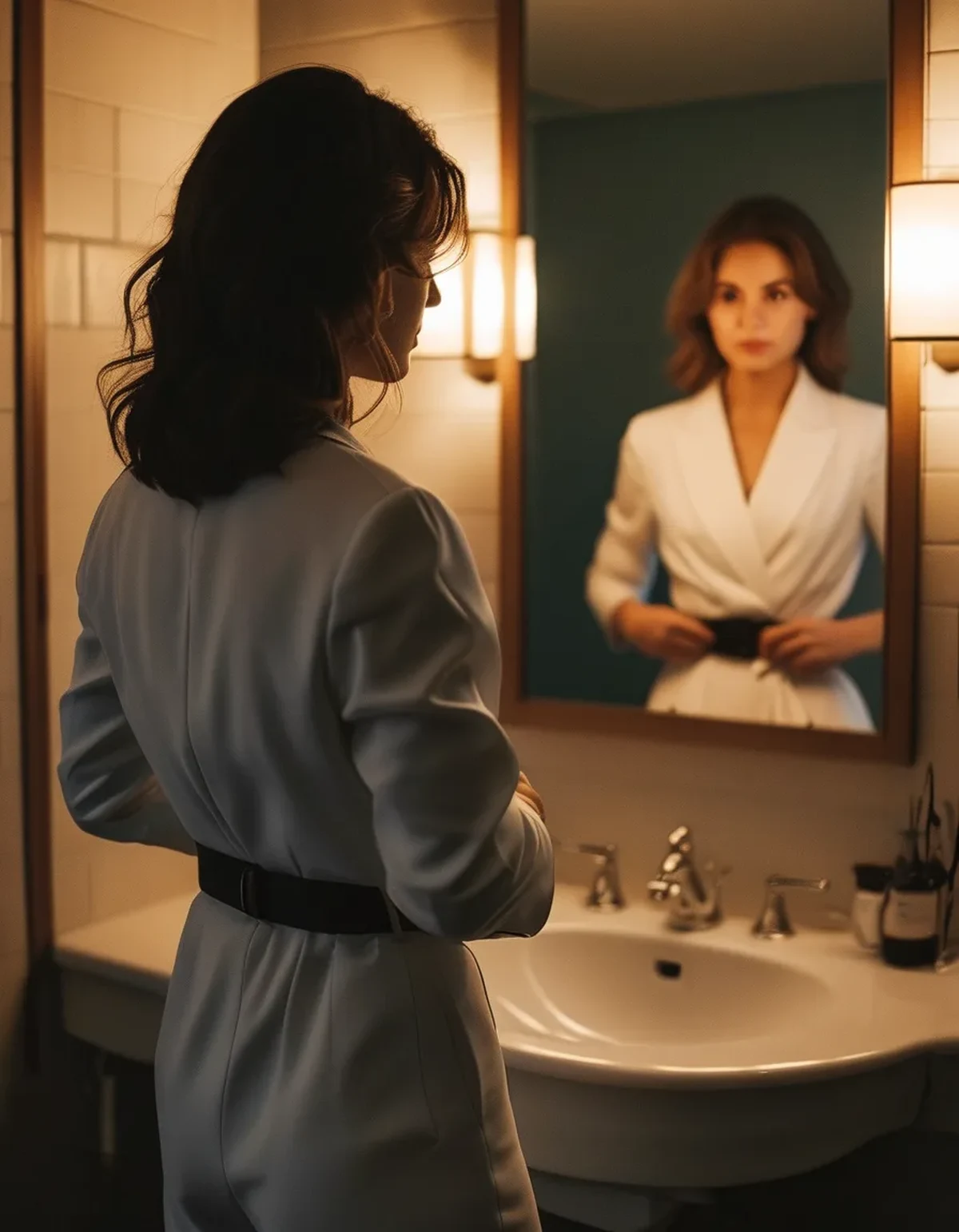
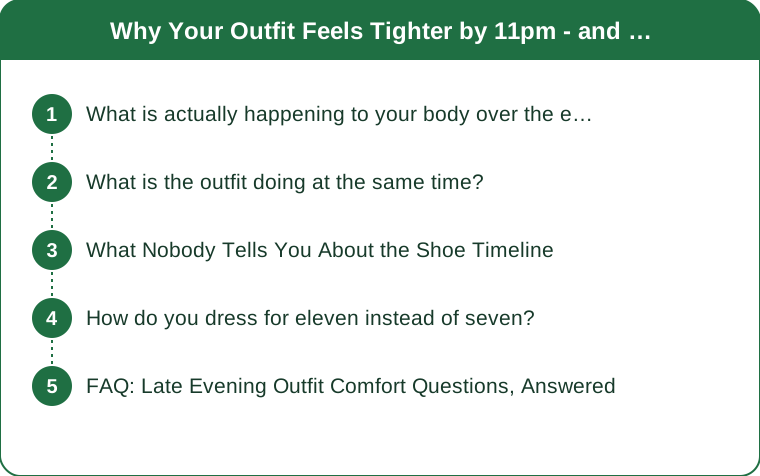
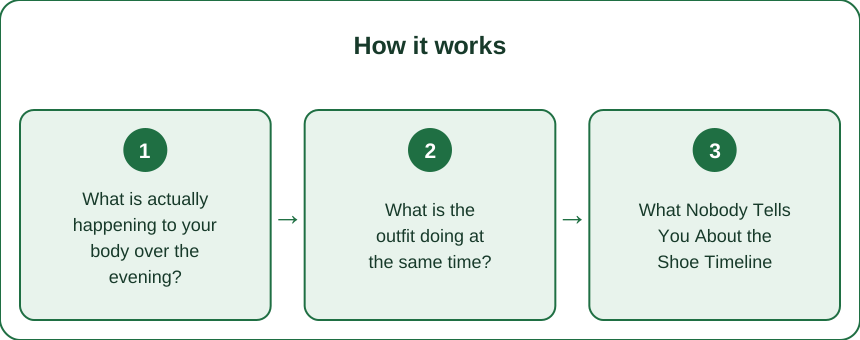
What is actually happening to your body over the evening?
Four processes, each modest on its own, and they arrive together.
Fluid moves downward and outward. Standing and sitting for hours lets fluid settle into your lower legs and feet - gravity plus reduced calf muscle pumping. Feet and ankles genuinely swell over an evening, which is why shoes that fit at seven pinch at eleven. This is normal physiology, not a warning sign.
Sodium pulls water into tissue. Restaurant food is far saltier than home cooking, because salt is how kitchens make food taste good quickly. A single restaurant meal can carry a substantial share of a day’s sodium, and the body holds extra water to keep sodium concentration in balance. That water shows up as puffiness at the waist, fingers, and face, typically within a few hours.
Digestion takes up room. A meal plus drinks has physical volume, and carbonated drinks add gas. This is the most obvious factor and also the most temporary.
Heat expands everything. A warm, crowded venue raises skin temperature, dilates blood vessels near the surface, and increases fluid movement into surrounding tissue. Hands and feet swell most noticeably - which is the specific reason rings feel tight on a dance floor.
All four peak at roughly the same time: several hours after you arrived, in a warm room, after a salty meal, having been upright the whole time. Around eleven, in other words.
The number people find reassuring: this is ordinary, temporary fluid distribution, and it resolves overnight when you lie flat and your kidneys catch up. It is not fat gain and it is not something to fix - it is something to dress for.
What is the outfit doing at the same time?
Moving in the opposite direction from your body, which is why the mismatch feels dramatic.
Elastic warms and relaxes - except where it matters. Body heat softens elastane, so a fitted dress often loosens through the body over an evening. But a thick waistband with heavy elastic behaves differently: it holds its shape while the fabric around it gives, concentrating pressure at one line. So a garment can feel looser overall and tighter at the waist at the same time. That is not your imagination.
Woven fabrics do not adapt at all. A structured woven with no stretch has a fixed circumference. Whatever your body does, the garment does nothing, so every bit of change registers as pressure. This is the main reason a rigid waistband is the highest-risk element of a night-out outfit.
Seams and hems shift with movement. Hours of sitting, standing, dancing, and reaching gradually move a garment on the body. A skirt rotates. A neckline creeps. A hem rides. None of this is a fit problem - it is what happens when clothes are worn actively rather than tried on standing still.
Fabric absorbs moisture and stiffens. Cotton and viscose take up humidity and perspiration and lose drape as they do, becoming heavier and clingier. Synthetics resist this better, which is one of the few clear arguments in their favor for a long evening.
So you have a body that is slightly larger, a waistband that has not moved, and fabric that has become clingier. Three small changes producing one large feeling.
What Nobody Tells You About the Shoe Timeline
Feet swell more than anything else, and shoe decisions are usually made at the exact wrong moment.
Feet are the furthest point from the heart and the lowest point in the body, so gravity-driven fluid pooling hits them hardest. Add heat, add hours of standing, add the compression of a fitted shoe restricting circulation, and by late evening your foot is meaningfully larger than it was when you left.
This explains a familiar sequence: shoes that felt fine in the shop, fine at home, fine walking to dinner, and unbearable by eleven. Nothing was wrong with the fit. The fit was measured against the wrong version of your foot.
What to do about it:
- Try shoes on in the evening, not the morning. Shoe fitters have recommended this forever and it is the single most useful piece of advice here. A shoe that fits at 6pm fits all night. A shoe that fits at 10am does not.
- Prioritize a strap over a slip-on for long evenings. An adjustable strap gives you a setting to let out. A fixed slip-on gives you nothing.
- Watch the toe box more than the heel height. Toe box width is where swelling shows up first and hurts most. Plenty of people can manage a higher heel comfortably in a wider shoe and cannot manage a low one in a narrow one.
- Bring the backup, and bring it early. Foldable flats in a bag work. Most people deploy them an hour after they should have - once you are in pain, damage to the foot has already started.
The genuinely surprising part: a slightly larger shoe can be worse. A foot sliding inside a loose shoe generates friction, and friction produces blisters faster than mild compression does. What you want is a shoe with adjustability, not one that is simply bigger.
How do you dress for eleven instead of seven?
Choose garments that have somewhere to go, and put the adjustability where the change happens.
Pick your waist treatment deliberately. In rough order from most forgiving to least: a soft elasticated waist, a wrap or tie waist you can loosen, a garment with no waist seam at all such as a slip or shift dress, a stretch waistband, and last, a rigid woven waistband. If you love a rigid waistband piece, keep it for evenings that are mostly sitting rather than mostly eating.
Favor drape over cling for long nights. Fabric that skims the body registers your changes far less than fabric that maps them. This is not about coverage - a fluid slip dress can be very fitted in feel while remaining forgiving in practice, because it moves with you instead of holding a fixed circumference.
Put the structure at the shoulder. Definition at the shoulder line - a jacket, a strong sleeve, a structured neckline - lets everything below be softer without the outfit reading as shapeless. This is a genuinely useful trick and it is the reason a blazer over a slip dress is such a durable formula.
Manage the inputs, gently. Drinking water between drinks helps more than most people expect - dehydration actually encourages fluid retention. Standing up and walking for a couple of minutes every hour restarts the calf pump and reduces leg pooling. Neither requires any planning.
Build in one change. Not a full outfit change - one element. Swapping shoes, removing a layer, or letting out a tie is usually enough to reset comfort completely. Knowing you have that option is itself worth something around hour four.
The underlying principle is simple: your body at eleven is the real client. Fit to that one.
FAQ: Late Evening Outfit Comfort Questions, Answered
Am I bloated or is this something to worry about?
Ordinary evening fluid shifts and digestive volume are normal and resolve overnight. What is worth mentioning to a doctor is swelling that persists into the morning, affects one leg noticeably more than the other, or comes with shortness of breath or chest discomfort. This is general information, not medical advice.
Does drinking less water help?
The opposite. Mild dehydration prompts the body to hold on to fluid, so restricting water tends to increase puffiness rather than reduce it. Steady water through the evening - especially alongside alcohol, which is dehydrating - is the more effective approach, and it helps you feel better the next morning too.
Why do my rings get tight before anything else?
Fingers have very little soft tissue to accommodate extra fluid, so a small change registers immediately. Heat makes it worse by dilating surface blood vessels. If you know it is going to be a warm crowded night, wearing rings loose or leaving the tightest ones at home saves you a genuinely awkward moment.
Is shapewear a solution or a problem?
Both, depending on fit. Correctly sized shapewear that smooths without compressing hard is fine. Shapewear sized down to compensate for a tight outfit becomes uncomfortable exactly when your body is largest, and heavy compression at the waist over several hours can make eating unpleasant. If you are wearing it, size it for eleven o’clock too.
TL;DR:
- Four things stack over an evening: fluid pooling from standing, sodium from restaurant food, digestive volume, and heat-driven vessel dilation.
- Meanwhile fabric warms and relaxes while a rigid waistband does not, concentrating all the pressure at one line.
- Feet swell most - try shoes on in the evening, favor an adjustable strap, and watch toe box width over heel height.
- Choose soft, tie, or seamless waist treatments; drape beats cling; put the structure at the shoulder and keep everything below forgiving.
- Water between drinks and a two-minute walk each hour genuinely reduce the effect, and one planned change resets comfort completely.
Fit the outfit to the version of you that exists at eleven, not the one standing in front of the mirror at seven.
Keep Reading
This article is for general informational and styling purposes only. Fit, sizing, and product availability may vary.