Why Your Late August Girls Night Outfit Needs a Plan for Two Temperatures

Quick Answer: Late August evenings drop faster than midsummer ones - often 15 to 20 degrees between 8pm and midnight - because the nights are longer and the sun is lower, so the ground gives up its heat sooner. Dressing for the 8pm patio and being cold by 11 is the single most common late-summer going-out mistake. The fix is a two-temperature outfit: a base that is genuinely comfortable at 84F, one deliberate layer that looks like part of the outfit rather than a rescue, and footwear chosen for the walk home rather than the entrance.
You left the house at 8pm and it was still warm enough that the jacket felt ridiculous. By 11 you were standing outside a bar with your arms crossed, borrowing someone’s cardigan and regretting the whole plan.
This happens more in late August than any other time of year, and there is a real reason for it.
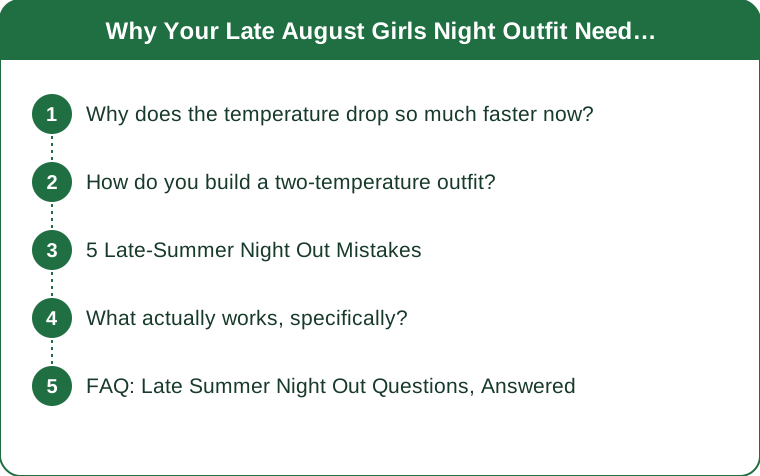
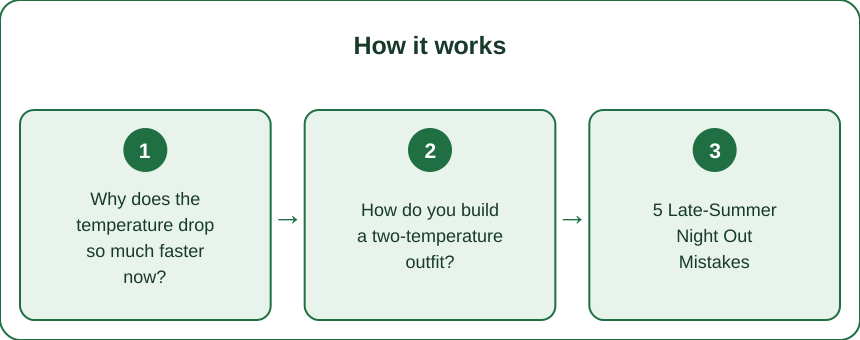
Why does the temperature drop so much faster now?
Because the night is longer and the sun angle is lower, so the cooling has more time to work.
Surfaces absorb heat during the day and radiate it back at night. In late June, the night is short and the daytime input is enormous, so the surface never gives all of it back before the sun returns. By late August the night is already about ninety minutes longer than at the solstice, and the daytime input is lower because the sun is at a shallower angle.
The result is a steeper evening curve. Same 84F afternoon, much colder 11pm.
Clear late-August nights are the worst case - clouds trap radiated heat, so a clear sky means faster cooling. If the forecast says clear and the afternoon was hot, the drop will be at the extreme end.
There is also a personal factor that people underestimate. You are dehydrated and probably underfed by 11pm on a night out, and both reduce your ability to generate heat. The same 64F feels genuinely colder at the end of a night than at the start of one, independent of what you are wearing.
So the outfit has to work at 84F standing on a patio and at 62F waiting for a ride - which is a bigger range than most single outfits are designed for.
How do you build a two-temperature outfit?
Start from the cold end, not the warm one.
Most people dress for the moment they leave the house, which is the warmest moment of the night. Dress for 11pm and make the 8pm version work by removing something, rather than dressing for 8pm and hoping.
The base should be comfortable alone at 84F. That usually means a woven rather than a knit, because woven fabric moves air. Linen blends, poplin, crepe and rayon all breathe. A close-fitting jersey looks fine and traps heat against the skin, which is exactly wrong for the first half of the night.
The layer has to look intentional. This is the part that decides whether you actually bring it. A cropped blazer, a slip-cut jacket, a fine knit cardigan in a deliberate color, or an oversized shirt worn open all read as part of the outfit at 8pm and as warmth at 11. A hoodie or a fleece reads as a rescue, which is why it stays home and why you end up cold.
Add one high-value warm accessory. A light scarf or a longer necklace-scarf hybrid occupies almost no bag space and covers the neck and upper chest, which is where cooling is felt first. It is the highest warmth-per-cubic-inch item you can carry.
And check the bag. If the layer does not fit in or over the bag you are carrying, you will leave it on a chair. Choose the bag after the layer, not before.
5 Late-Summer Night Out Mistakes
1. Bare shoulders with no plan. Shoulders and upper arms are where a temperature drop registers first. A strapless or thin-strap top is a great 8pm choice and a bad 11pm one, and it only works if the layer is genuinely coming with you.
2. Choosing shoes for the entrance. Late August nights involve more outdoor walking than winter ones - patios, walks between places, waiting outside for rides. The shoe has to survive the walk home, and a block heel or a structured flat does that in a way a stiletto on late-summer pavement does not.
3. Ignoring the humidity in the makeup plan. An 84F humid evening and a 62F dry one are two different environments for anything on your face. A setting spray does more for a late-August night than a heavier foundation, which will move in the first two hours regardless.
4. Wearing the fabric that shows everything. Silk, satin and pale cotton all show heat marks in the warm half of the night. Textured fabrics, prints, and mid-tones do not. This is a two-second choice that decides whether you are checking yourself all evening.
5. Not eating before, then blaming the outfit. You will feel a 62F evening dramatically colder on an empty stomach. This is not a styling issue, but it is the single most common reason a perfectly reasonable outfit fails.
What actually works, specifically?
Three combinations that handle the whole range.
The slip and the shirt. A slip dress in a woven fabric plus an oversized cotton or linen shirt worn open. At 8pm the shirt hangs off one shoulder or ties at the waist. At 11pm it buttons. This is the most reliable two-temperature outfit that exists because both halves are complete looks.
Wide leg and a fitted knit. Wide-leg trousers in a flowing fabric move air around the legs, which handles the warm half, and cover the legs, which handles the cool half. Pair with a fitted, short knit top and a cropped jacket over. The legs never get cold, which is most of the problem solved without carrying anything bulky.
The long dress and the light knit. A maxi in a breathable woven, plus a fine-gauge cardigan. The dress solves leg coverage, the cardigan solves shoulders, and the whole thing packs down to nothing.
Whatever you pick, do the doorway test: stand outside for two minutes before you leave, in the actual evening air, wearing the actual outfit. If you are already thinking about the temperature, it will not survive to midnight. That two minutes has saved more nights than any amount of planning indoors.
FAQ: Late Summer Night Out Questions, Answered
How much colder does it actually get?
On a clear late-August night, a 15 to 20 degree drop between 8pm and midnight is typical in most of the country, and inland and higher-elevation areas can be more. Coastal areas drop less but add wind, which makes the effective temperature feel similar. Check the overnight low, not the evening temperature - you will feel something close to it by the end of the night.
Is a jacket over the shoulders actually warm enough?
It covers the area where you feel cold first, which is why it works better than it should. But it stops working the moment there is any wind, because it has no closure. If it is breezy, wear it properly or bring something with a front.
What is the single best thing to carry?
A light scarf. It takes up almost no space, covers the neck and chest, works as a wrap over the shoulders, and does not look like emergency clothing. If you only bring one extra item to a late-August night out, bring that.
TL;DR:
- Late August nights drop 15 to 20 degrees between 8pm and midnight, far more than midsummer ones.
- Dress for 11pm and subtract, rather than dressing for 8pm and hoping.
- The layer only works if it looks like part of the outfit - a hoodie stays home and you stay cold.
- Wovens over knits for the base: they move air in the warm half of the night.
- Choose the shoes for the walk home, not the entrance.
- A light scarf is the highest warmth per bag space you can carry.
The outfit is not the problem. Planning it for one temperature on a night that has two is.
See It in Motion
Seen here: High Waist Drawstring Wide Leg Yoga Pants with Pockets — shop it on bubblelime.com
Keep Reading
This article is for general informational and styling purposes only. Fit, sizing, and product availability may vary.