Why the First Outfit You Try On Is Usually the Right One

Quick Answer: Your first pick is made with your fullest attention and your clearest sense of the occasion, before decision fatigue sets in. Every subsequent try-on is judged against a mental image that keeps shifting, and by the fifth outfit you are no longer evaluating clothes - you are evaluating your own indecision. Set a two-outfit limit, use a fixed decision rule, and get ready in the order that puts the outfit decision earliest.
The bed is covered. You have been at this since seven. You are now standing in the first thing you put on, wondering how you spent forty minutes arriving back where you started. This is not a wardrobe problem, and buying more clothes will make it measurably worse.
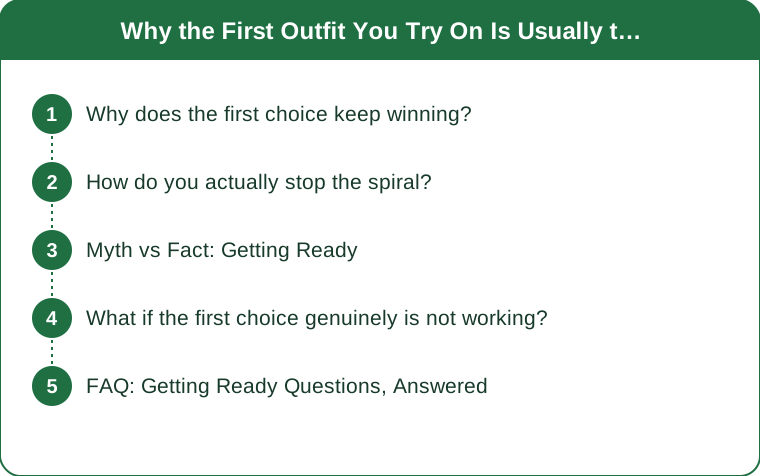
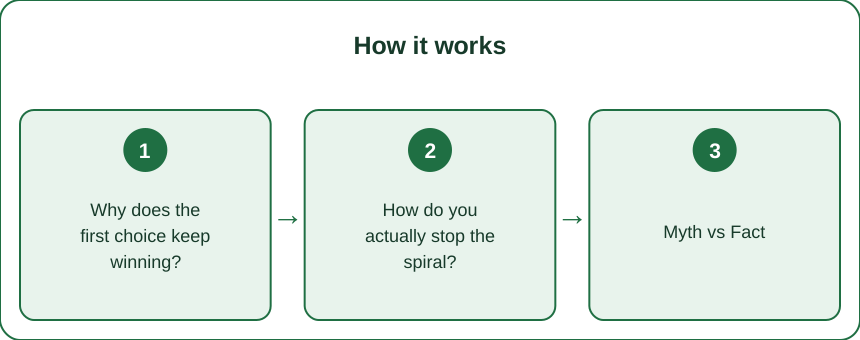
Why does the first choice keep winning?
Because it is made under conditions the later ones never get.
It is made with the occasion clearest in mind. When you first open the wardrobe you are thinking about the actual evening - who, where, how cold, how much walking. That mental picture is the correct criterion, and it is sharpest at the start.
It is made before any comparison exists. The first outfit is judged against the occasion. The third is judged against the first two, and the sixth is judged against a blurred composite of everything you have already rejected. Comparison drifts away from the question that matters, which was never which of these is best but whether this works for tonight.
Decision fatigue is real and it is fast. The quality of decisions degrades measurably as the number of decisions increases within a session, and getting dressed involves far more decisions than it feels like - top, bottom, layer, shoes, bag, jewellery, and every combination of those.
Each rejection raises the bar irrationally. Having rejected four things, you now unconsciously require the fifth to justify the rejections. Nothing can, because the rejections were not evidence about anything.
And the mirror is not a stable instrument. Lighting, angle, posture, and how recently you ate all change what you see. Two viewings of the same outfit twenty minutes apart genuinely look different, which means the comparison you think you are making is not the comparison you are actually making.
The exception worth naming: first choices go wrong when they were made on autopilot rather than with attention - reaching for the default because it is the default. That is a different failure and it has a different fix, which is deciding earlier rather than deciding more.
How do you actually stop the spiral?
With rules made before you are tired, because rules made while tired are just more decisions.
Set a hard limit of two try-ons. Choose one, try it, and if it works, stop. If it genuinely does not, choose one alternative, and pick between those two. The third try-on is where the spiral starts, and simply not taking it removes the problem.
Decide the night before, or at least decide the anchor piece. Choosing when you are not under time pressure produces a better decision and removes the decision from the tired window entirely. Even choosing only the anchor - the one item everything else builds around - collapses the option space enormously.
Use a fixed rule instead of judgement. A rule can be as simple as: one fitted piece, one relaxed piece, one thing you like about yourself emphasised. Rules are not creatively limiting, they are decision-limiting, which is the actual bottleneck.
Get dressed before makeup, not after. Doing hair and makeup first means you arrive at the outfit decision already thirty or forty minutes into your attention budget - and you also cannot try things on freely without ruining them. Outfit first is both a fresher decision and a more practical one.
Put rejected items away immediately. A pile on the bed is a visual reminder of unresolved options and it keeps the comparison running. Hanging something back up closes the loop.
Photograph, do not stare. One photo from the front at arm’s length tells you more in three seconds than three minutes of mirror scrutiny, because it is stable and it is roughly what other people see. It also stops the loop where you notice a new flaw every ninety seconds.
And use a start time, not a finish time. Deciding to leave the bedroom at 8:15 regardless of resolution is far more effective than deciding to start getting ready at 7:30. Constraints that bind at the end are what stop open-ended processes.
Myth vs Fact: Getting Ready
Myth: More options means a better outfit. Fact: Beyond a small number, more options reliably produces slower decisions and lower satisfaction with whatever is chosen. A full wardrobe with nothing to wear is not a contradiction - it is the predictable outcome of too many possibilities and no rule for choosing among them.
Myth: You’ll know it when you see it. Fact: You will know it when you see it first. After several try-ons, the sense of certainty degrades along with everything else, which is why people so often end up back at the first choice - not because it was objectively best, but because it was the last one they evaluated clearly.
Myth: Taking longer means caring more. Fact: Taking longer usually means the decision was under-specified at the start. Someone who decided the anchor piece yesterday afternoon and is out of the door in fifteen minutes has not cared less; they front-loaded the thinking.
Myth: A photo is unflattering and misleading. Fact: A photo is a fixed sample - one angle, one moment, one lighting condition, and lenses do distort at close range. But it is stable, which the mirror is not, and stability is what an indecisive process needs. Use it to decide, not to critique.
Myth: If you are second-guessing it, it is wrong. Fact: Second-guessing after forty minutes is a symptom of fatigue, not information about the outfit. The same outfit felt right at minute two. Nothing about it changed.
What if the first choice genuinely is not working?
Sometimes it is not, and there is a way to tell the difference quickly.
Ask one specific question: what exactly is wrong? If you can name it - the trousers are too warm for a crowded room, the shoes cannot handle the walk from the car, the neckline does not work with the necklace - it is a real problem with a targeted fix, usually one substitution rather than a whole new outfit.
If you cannot name it, it is probably mood rather than fit. Nothing feeling right often tracks with how the day went, how tired you are, or how much you are looking forward to the evening. That feeling does not resolve by changing clothes, which is why the sixth outfit does not fix it either.
Change one variable, not all of them. Swapping the shoes or the layer while keeping the anchor piece is a small decision with a fast answer. Starting from scratch resets you to a decision you already made worse by making it late.
Consider comfort seriously, because it is usually the real complaint. An outfit that looks right and cannot be sat, danced, or walked in will feel wrong all evening and you will attribute that to how it looks. Test it: sit down, raise your arms, walk ten steps. Most late-stage doubt is a comfort signal wearing a style costume.
And factor in the weather honestly. Late-summer evenings drop temperature faster than the afternoon suggests, and getting cold outside a venue at eleven is the single most common source of I-wish-I-had-worn. Building in one layer that can be carried solves it without changing the outfit at all.
One useful reframe: almost nobody at the event will register the details you have spent forty minutes on. They will register whether you look comfortable and whether you seem glad to be there, and both of those are damaged rather than improved by the forty minutes.
FAQ: Getting Ready Questions, Answered
Why do I always go back to the first outfit I tried on?
Because it was chosen with your clearest attention and with the actual occasion in mind, before comparison and fatigue took over. Later try-ons are judged against a shifting mental composite of everything already rejected rather than against the question of whether it suits the evening.
How can I decide what to wear faster?
Decide the anchor piece the night before, cap yourself at two try-ons, and use a fixed rule - one fitted piece, one relaxed piece, one thing emphasised - so you are applying a rule rather than making an open-ended judgement. Also set a leave-the-room time rather than a start time.
Should I do makeup or get dressed first?
Get dressed first. It puts the outfit decision at the front of your attention budget when it is sharpest, and it lets you try things on without worrying about ruining makeup, which is one of the quiet reasons people avoid changing and then feel unsettled all evening.
Is it normal to hate everything in my wardrobe before going out?
Extremely, and it usually correlates with tiredness or ambivalence about the evening rather than with the clothes. If you cannot name a specific problem with what you have on, the problem is unlikely to be solvable by changing it.
How do I stop the pile on the bed spiral?
Put each rejected item away as you reject it. The pile keeps the comparison running visually and reminds you of unresolved options, which is exactly what sustains the spiral. Closing each loop as you go is a small mechanical habit with a disproportionate effect.
TL;DR:
- The first pick gets your clearest attention and the actual occasion in mind; later picks get fatigue.
- Cap it at two try-ons - the third is where the spiral starts.
- Decide the anchor piece the night before and use a fixed rule, not open-ended judgement.
- Get dressed before makeup, photograph instead of staring, and put rejects away immediately.
- If you cannot name what is wrong, it is mood, not the outfit, and a sixth try-on will not fix it.
Forty minutes, one pile, back in the first thing. Not a wardrobe problem - a process problem, and processes can be fixed.
Keep Reading
This article is for general informational and styling purposes only. Fit, sizing, and product availability may vary.