How to Dress for a Night That Starts at Dinner and Ends Dancing

Quick Answer: Dress for the last venue, not the first. The dance floor is the hardest test of the night - heat, movement, hours of standing - so build the outfit to pass it, then add one removable layer for the over-air-conditioned dinner. Block heels or dressy flats over stilettos, a crossbody instead of a clutch, breathable fabric over anything that shows heat, and every hem and strap must survive the sit-test and the arms-up test before you leave the house.
The outfit that looked perfect across a dinner table starts failing around 11:15 - the shoes first, then the strapless neckline, then the fabric that turned into a personal sauna. The trick is that dinner outfits and dancing outfits are different species, and the night needs one animal that can do both.

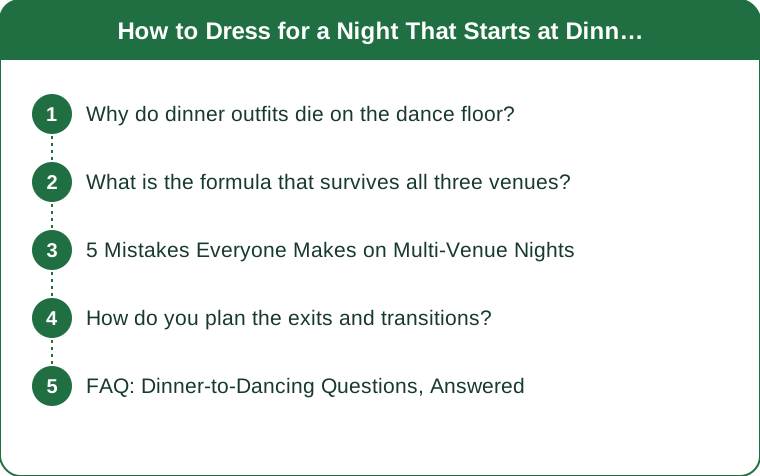
Why do dinner outfits die on the dance floor?
Because the two venues make opposite demands, and most outfits are built for the first two hours instead of the last two.
Dinner is a seated, cold-air event. Restaurants run their AC hard in late summer, you are stationary for ninety minutes, and the outfit is viewed from the waist up across a table. Structured pieces, delicate fabrics, and ambitious shoes all thrive here - nothing is being asked of them.
The dance floor is a standing, hot, high-motion event. Body heat plus crowd plus movement means every layer becomes cargo, every synthetic that cannot breathe becomes a greenhouse, and every shoe is load-bearing for hours. The pieces that starred at dinner are suddenly the problem: the blazer has no home, the satin shows every degree of heat, the stilettos have a countdown timer.
The transitions are their own micro-climate. The walk between venues and the rideshare wait at 1 a.m. are the coldest moments of the night - late-August evenings drop faster than the afternoon promised. This is where the removable layer earns its place: not for dinner comfort, for the sidewalk in between.
Bags change value as the night goes on. A clutch is charming at a table and a liability in a crowd - it occupies a hand you want free, and set-it-down moments multiply. A small crossbody holds phone, card, lipstick, and gum, and disappears from your attention entirely, which is the whole point.
And fabric is the silent variable. Heat management is the difference between a top that still looks fresh in photos at midnight and one that visibly gave up. Crepe, matte jersey, poplin, and anything with real airflow outlast satin and heavy synthetics every single time.
What is the formula that survives all three venues?
One anchor, one layer, three vetoes.
Anchor the outfit on a bottom that moves. A slip skirt, a floaty midi, tailored wide-leg trousers, or - the quiet current favorite - dressy flare leggings in a thick matte knit with heels and a silk cami. The test is identical for all of them: can you sit, dance, and stride without managing the garment? A bottom that needs tugging fails the night before the night starts.
Choose a top with a working neckline. Something that stays put when your arms go up. Fitted tanks, wrap styles that are actually secured, one-shoulders with structure - all fine. Strapless without internal grip is a two-hour commitment to hoisting.
Add the one removable layer. A cropped jacket, a fine-knit cardigan, or a big soft scarf that ties onto the bag strap when retired. It works the frigid restaurant and the 1 a.m. sidewalk, then vanishes. Tied at the waist on the dance floor is not a style crime; losing the night’s photos to visible shivering is.
Shoes: block heel, low platform, or genuinely dressy flat. The stiletto trades four hours of comfort for one seated hour of looks, and it is the single most regretted decision of multi-venue nights. A block heel gives the height and the silhouette and still exists as a functional shoe at midnight.
Bag: small crossbody, worn through dinner too. Consistency means nothing gets left on a chair.
Jewelry that locks. Secure earring backs, no bangles that fly. One statement piece maximum - the dance floor edits accessories for you, roughly.
Fabric rule, once more, because it decides the photos: if it cannot breathe, it cannot come. Buttery-soft matte knits, crepe, and jersey read elevated and vent heat; shine plus synthetic equals visible struggle by 11.

5 Mistakes Everyone Makes on Multi-Venue Nights
1. Dressing for the restaurant and hoping. The dinner venue is the easiest test of the night - flattering light, seated, climate-controlled. Building the outfit to peak there is optimizing for the part that needed no optimizing. Reverse it: build for the floor, borrow polish back with the layer and the jewelry.
2. Debuting new shoes. A first wear that includes four standing hours is not a debut, it is a hazing. The night’s shoes must have at least one full evening on their record. No exceptions, including - especially - the pair bought for this outfit.
3. The big beautiful bag. A tote or oversized clutch means a full hand, a chair-check at every venue, and a spatial-awareness tax in every crowd. If it does not fit in a crossbody, the night does not need it. Phone, one card, ID, lipstick, gum, hair tie. Done.
4. Skipping the layer because the afternoon was warm. August afternoons write checks that August midnights do not cash. The restaurant will be cold on arrival and the sidewalk cold at departure - the two bookends of the night both want the layer that the 6 p.m. mirror voted against.
5. No pre-flight check. Every outfit gets thirty seconds before leaving: sit down fully, raise both arms overhead, walk ten fast steps. Whatever slips, gapes, rides, or pinches in the bedroom will do it hourly all night. The bedroom version is fixable; the version at the second venue is not.
Bonus: planning zero food after 8 p.m. Dancing on a dinner from six hours ago ends nights early. The group that splits late fries is the group still laughing at 1:30.
How do you plan the exits and transitions?
The unglamorous logistics that decide whether the night ends by choice or by surrender.
Know each venue’s coat situation before you commit to carrying anything. A bar with no coat check turns a proper jacket into a held object for three hours. This is why the tie-able layer beats the structured one for multi-stop nights - it has a parking spot on your body or your bag strap.
Stage the night’s cash-and-card in the crossbody before dinner. Splitting checks, cover charges, and the late-night water bottle all go faster when the bag was organized at 7 instead of excavated at 11.
Set the shoe bail-out plan honestly. If your feet have a known quitting time, either carry foldable flats in the crossbody - the tiny ballet styles genuinely fit - or accept the block-heel answer from the start. The barefoot-on-the-sidewalk finale is a worse look than any sensible shoe ever was.
Assign the rideshare moment. The wait outside is the coldest, most tired stretch of the night. The layer comes back on, someone’s phone has battery because someone charged at dinner - decide at dinner whose - and the pickup pin gets set while still inside the venue, not on the curb.
Protect the photo window. The best group photos happen early-middle, around the second venue, while everything is still fresh. Take them then, on purpose, instead of remembering at 12:40.
And build the morning into the night. Water at the last venue, the crossbody emptied onto the dresser, and the outfit hung rather than floored - three thirty-second moves that the next morning thanks you for loudly.
The real principle: transitions are the night. Venues take care of themselves; the walks, waits, and hand-offs between them are where the outfit and the plan either work or do not.
FAQ: Dinner-to-Dancing Questions, Answered
What shoes work for both a nice dinner and a dance floor?
Block heels are the category answer - two to three inches of height, a stable base, and dinner-appropriate looks in every finish. Low platforms and embellished flats also pass both tests. The stiletto fails the second venue, and any shoe on its first-ever wear fails both. Nothing new, nothing untested, nothing with a known countdown.
How do I keep from overheating when the dancing starts?
Fabric first: breathable matte knits, crepe, jersey, poplin - and nothing satin or heavy synthetic against the skin. Then structure: the removable layer comes off before the floor, hair goes up with a tie you brought, and the drink in hand between songs is water more often than not. Overheating is mostly a fabric decision made hours earlier.
What bag actually works for a multi-stop night?
A small crossbody, worn from dinner onward. It keeps both hands free in crowds, cannot be left on a chair, and forces the correct packing list: phone, card, ID, lipstick, gum, hair tie, foldable flats if your shoes need an exit plan. Clutches photograph beautifully and then spend the night being managed.
Can leggings really work for a night out?
Dressed correctly, absolutely. Thick matte flare leggings with heels and a silk cami or structured top read as tailored trousers in motion and outperform them on the dance floor. The failures are thin fabric, athletic styling, or sneakers-by-default - the difference between gym leggings and a night-out flare is fabric weight, finish, and everything worn above it.
TL;DR:
- Dress for the last venue - the dance floor is the hard test - and borrow dinner polish back with a removable layer.
- Block heels or dressy flats; the stiletto has a countdown timer and it ends mid-night.
- Small crossbody from dinner onward: phone, card, lipstick, gum, and maybe foldable flats.
- Breathable matte fabrics survive; satin and heavy synthetics show every degree by 11 p.m.
- Sit-test and arms-up test before leaving - and the layer comes even when the afternoon argues.
The night does not end when people get tired. It ends when the first person’s outfit does - and it is never the one who planned for midnight.
See It in Motion
Seen here: High Waist Bootcut Yoga Pants with Side Pockets — shop it on bubblelime.com
Keep Reading
This article is for general informational and styling purposes only. Fit, sizing, and product availability may vary.