The Girls Night Outfit for Evenings That Turn Cold at 10pm

Quick Answer: Late summer evenings drop 8 to 12C between 7pm and midnight, which is a bigger swing than most winter nights. The outfit that solves it is not a warmer outfit - it is one warm layer you genuinely like, chosen so that removing it changes the look rather than ruining it. Build the outfit so it works both with and without the layer, and the temperature stops being a decision you have to get right in advance.
The error almost everyone makes: bringing a jacket that only functions as a jacket, then carrying it all night.
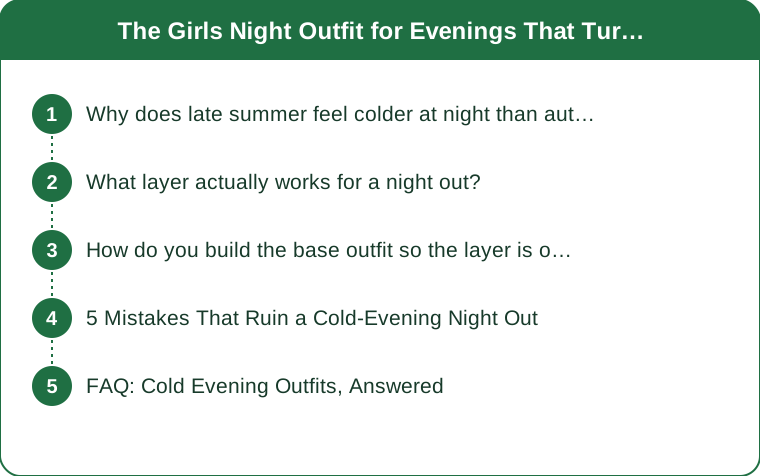
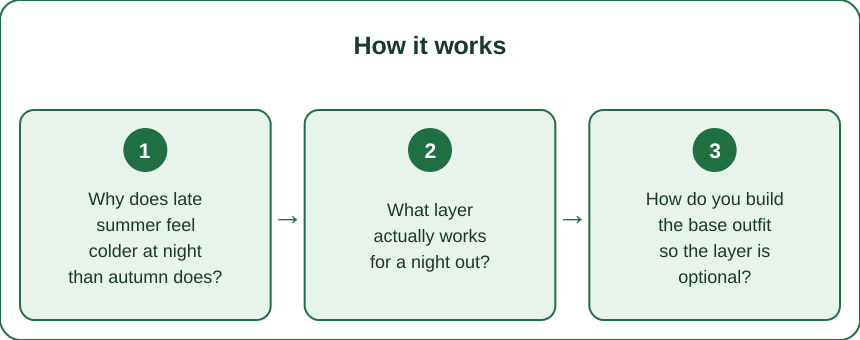
Why does late summer feel colder at night than autumn does?
Because the swing is bigger and you dressed for the top of it.
The actual numbers. In late August, clear-sky evenings routinely drop 8 to 12C between 7pm and midnight, and in dry inland areas the swing can exceed 15C. A November evening might only drop 3 or 4C, because cloud cover and humidity hold the heat in. So the coldest-feeling night of your month is frequently a summer one.
Three things that amplify it:
- You dressed at 6pm for 26C, which was correct at the time and wrong four hours later
- You have been indoors in air conditioning, and coming out into cool air after a chilled room feels far colder than the thermometer says
- Alcohol causes peripheral vasodilation, which makes you feel warm while accelerating actual heat loss. You feel warmest exactly when you are losing heat fastest - which is why the walk home is the worst part
Where the heat is actually lost. Bare shoulders, upper arms, and upper back - a substantial surface area with little insulating tissue. Covering the shoulders alone changes perceived warmth dramatically compared with, say, covering the legs. This is why a shawl works better than it should.
The transitional detail people miss. Wind matters more than temperature at this point in the year because you are in summer fabrics. A light breeze on bare arms in 15C air feels like 10C. A layer that blocks wind beats a layer that is merely thick, which is why a thin leather or denim jacket often outperforms a chunky knit.
What layer actually works for a night out?
One that is part of the outfit rather than a fix for it.
The test. Take a photo with the layer on and one with it off. If both look intentional, the layer is right. If the with-layer version looks like someone borrowed a coat, it is wrong - and you will end up carrying it, which is the outcome you were trying to avoid.
What performs well:
- A cropped or fitted leather or faux-leather jacket. Blocks wind, reads as deliberate, works over almost any silhouette
- A structured blazer, ideally slightly oversized. Currently the most versatile option and it survives being taken off and put back on
- A fine-knit cardigan in a good yarn. Lighter than it looks, and can be worn open, buttoned, or over the shoulders
- A large scarf or pashmina, which is the highest warmth-to-bulk option and can be worn three or four ways. Covers the shoulders, which is where the heat goes
- A long waistcoat, which adds a core layer with no sleeves to fight against
What tends to fail:
- A heavy winter coat, which is too much for 15C and impossible to carry
- A denim jacket over a delicate fabric, where the weight difference reads as mismatched
- Anything that crushes. If it looks slept-in after an hour over your arm, it will
- A borrowed-feeling layer in a colour or weight unrelated to the rest of the outfit
The fabric point that matters more than thickness. Wind resistance beats insulation in this temperature range. A thin tightly-woven layer outperforms a loose chunky knit at 15C with a breeze - the knit lets air straight through.
The practical detail. Choose something with pockets or that ties. A layer that can be secured around the waist or worn over the shoulders when you are too warm indoors is a layer you will still have at 1am, rather than one left on the back of a chair.
How do you build the base outfit so the layer is optional?
By making the outfit work at both temperatures rather than picking one.
The core principle. The base outfit should be complete on its own - not something that needs the jacket to look finished, and not so warm that the jacket is unwearable indoors.
Structural choices that give you range:
- Sleeveless rather than strapless. Strapless commits you to bare shoulders permanently; a sleeveless top or dress with actual shoulder coverage handles a 15C moment on its own
- A midi length rather than a mini, which changes leg exposure substantially at no cost to the look
- Closed-toe shoes, which matter more than most people expect. Cold feet drive the perception of being cold overall, and a sandal at midnight in late August is genuinely uncomfortable
- A fabric with some body - crepe, ponte, a heavier satin - rather than something that goes cold and clammy the moment the air does
The tights question. Sheer tights add a genuine 2 to 3C of perceived warmth with almost no visual change to a dark outfit. In late August they read as slightly early, but on a genuinely cold evening they are the single most efficient warmth-per-visual-change decision available.
The layering-underneath option that nobody talks about. A fine seamless base layer under a dress - a thin long-sleeve or a fitted vest in a matching tone - adds warmth invisibly. It sounds unglamorous and it means you can wear the outfit you actually wanted.
The bag decision, which is really the layer decision. If your bag cannot hold your layer, you will not bring the layer. A small shoulder bag forces you to wear the jacket all evening or carry it all evening. Either size up the bag or choose a layer that packs down - a fine knit or pashmina folds to nothing; a leather jacket does not.
The venue-transition point. Most cold-evening problems happen in the gaps: waiting for a table, standing outside, walking between places. Those gaps are usually 10 to 20 minutes total across a night. You are not dressing for the whole evening being cold - you are dressing for twenty scattered minutes, which is a much easier problem.
5 Mistakes That Ruin a Cold-Evening Night Out
1. Checking the daytime forecast rather than the 11pm one. The afternoon high tells you nothing useful. Look at the temperature for the hour you will be leaving, which in late August is frequently 10C lower than when you got dressed.
2. Bringing a jacket that does not go with the outfit. You will take it off in the first venue, carry it all night, and either leave it behind or resent it. If it does not photograph well, it is not the layer.
3. Wearing open shoes because the afternoon was warm. Foot temperature drives whole-body cold perception disproportionately, and standing on cold pavement outside a venue at midnight is where nights get cut short.
4. Trusting the warmth that alcohol provides. It feels like warmth and it is accelerated heat loss - you are coldest when you feel warmest. Put the layer on before you feel you need it, not after.
5. Carrying a bag your layer will not fit into. This forces a binary choice all evening. Either the layer packs down or the bag is bigger - there is no third option, and this gets decided at home, not at the door.
All five come from making the decision at 6pm for 6pm conditions. Make it once, for midnight, and the evening looks after itself.
FAQ: Cold Evening Outfits, Answered
How much does the temperature actually drop on a late summer evening?
Typically 8 to 12C between 7pm and midnight on a clear night, and more inland or in dry air. That is often a larger swing than a winter evening, when cloud cover holds heat in.
Why do I feel colder than the temperature suggests?
Three reasons stacking: you came out of air conditioning, you are in summer fabrics with no wind resistance, and alcohol dilates peripheral blood vessels so you lose heat faster while feeling warmer.
What is the warmest layer for the least bulk?
A large fine-wool or cashmere-blend scarf or pashmina. It covers the shoulders and upper back where most heat is lost, packs into a small bag, and can be worn several ways.
Do tights actually help?
Yes - sheer tights add roughly 2 to 3C of perceived warmth for almost no change to how a dark outfit reads. They are the most efficient warmth-per-visual-cost item available.
Should I bring a jacket if the venue is indoors?
Yes, because the cold happens in the transitions - queuing, smoking areas, walking between places, waiting for a car. Those add up to perhaps twenty minutes, and they are what determines whether you stay out.
How do I stop losing my jacket over the course of the night?
Wear it rather than carrying it, choose something that ties at the waist or sits over the shoulders indoors, or pick a layer that packs into your bag. A jacket on the back of a chair is a jacket you are going to forget.
TL;DR:
- Late summer evenings drop 8 to 12C between 7pm and midnight - dress for the leaving time, not the arriving time
- Choose a layer that looks intentional both on and off, or you will carry it all night
- Wind resistance beats thickness at 15C - a thin leather jacket outperforms a loose chunky knit
- Cover shoulders and choose closed shoes; those two change perceived warmth more than anything else
- Alcohol makes you feel warm while you lose heat faster, so layer up before you think you need it
The outfit that survives a cold evening is not warmer. It is the one that works two ways, so the temperature never becomes a decision you have to make correctly at six o’clock.
Keep Reading
This article is for general informational and styling purposes only. Fit, sizing, and product availability may vary.