Rooftop Bars Are Windier Than Anyone Warns You

Quick Answer: Wind speed increases with height, so a rooftop eight floors up is meaningfully windier and feels several degrees colder than the street you just left. The two things that ruin rooftop outfits are lightweight flowing fabrics and anything that relies on staying in place. Choose weight over volume, secure the hem, bring one compact layer, and accept that your hair will not survive in the style it arrived in.
You get out of the lift and the first gust takes your dress, your hair and your composure in one movement.
Rooftops are worth it. They just need to be dressed for as a different venue from the bar on the ground floor.

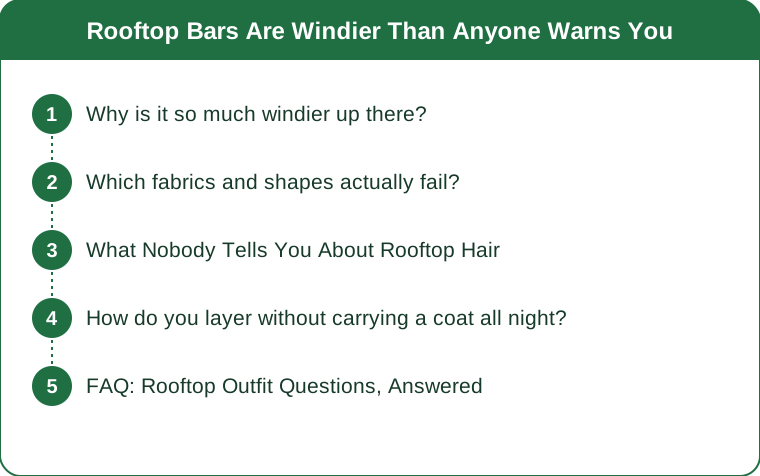
Why is it so much windier up there?
Because wind speed increases with height above the ground, and buildings make it worse rather than better.
Near the ground, friction from buildings, trees and street furniture slows air down. Remove that friction by going up eight or ten floors and the same weather system is moving noticeably faster across your table than it was across the pavement.
Buildings channel and accelerate air. Air pushed against a tall building has to go around or over it, and it speeds up as it does. That is why the corner of a rooftop terrace can be still and the edge by the parapet is a wind tunnel, and why a rooftop can be gusty on a day the forecast called calm.
Evening is when the temperature drop bites. Air temperature falls after sunset, and moving air strips heat from skin faster than still air does — the same effect that makes a breezy 18C feel like 14C. On a rooftop after 9pm in late summer, that combination is why everyone ends up huddled by the heaters.
Late August and September are the specific problem window. Days are still genuinely warm, so you dress for the afternoon. But sunset is arriving earlier each week and the temperature drop after dark is much steeper than it was in July. An outfit chosen at 6pm in daylight is being worn at 10pm in the dark at a completely different temperature.
Humidity makes it worse, not better. Damp evening air conducts heat away from skin faster than dry air. A humid, breezy rooftop feels colder than a dry one at the same reading.
Which fabrics and shapes actually fail?
The failures are predictable, and mostly about weight and how much fabric is free to move.
Anything very light and loose is the worst case. Chiffon, thin viscose, light satin and unlined slip dresses catch air like a sail. The problem is not only lift — it is constant movement, which means constant adjusting, which means you spend the evening managing your clothes instead of the conversation.
Wrap dresses and front-slit skirts open. Anything held by a tie or overlapping panels relies on gravity, and wind removes gravity from the equation. If you love the shape, a discreet safety pin or a fashion tape strip at the overlap solves it entirely and takes ten seconds.
Wide-leg trousers behave far better than skirts, which is the useful non-obvious point. They move dramatically, which looks good, but there is no exposure risk and no hem to hold. For a known rooftop, they are the reliable choice.
Fabric weight beats fabric coverage. A heavier crepe, a ponte, a denser knit or anything with a lining hangs rather than flies. A long light skirt is far more trouble than a shorter heavy one.
Bare shoulders are colder than bare legs. Wind hits the upper body most directly, and heat loss from shoulders, upper back and neck is what makes people cold first. If you are choosing where to cover, cover up top.
Strapless anything requires maintenance in wind. Grip tape and correct sizing do work, but you will be aware of it all evening, which is the cost.
Shoes matter more than expected. Rooftops have decking, gravel, drainage channels and cable covers. Fine stiletto heels find every gap. A block heel or a sturdy platform is genuinely more practical without giving up height.

What Nobody Tells You About Rooftop Hair
It will not survive, and planning for that is far more comfortable than fighting it.
Down and freshly styled is the highest-maintenance choice. Any smooth blow-dry lasts about four minutes in a real breeze, and you will spend the evening pulling it out of your lip gloss. This is not a hairspray problem — hairspray holds a shape against gravity, not against a wind that lifts each section independently.
Half-up styles are the good compromise. The top and front are secured where the wind does the most damage, and the length still moves. This reads as intentional in photographs where fully-down hair reads as windswept.
A low bun or a slick-back is the genuinely wind-proof answer, and it also photographs well against a city backdrop because it keeps the face clear.
Bring two spare hair ties and a couple of pins. The single most useful thing in your bag. Being able to convert your hair mid-evening is what lets you enjoy an outdoor table rather than migrating inside.
Texture spray beats hairspray outdoors. It gives grip and separation, which survive movement. Firm-hold hairspray in wind produces a shape that breaks and then looks broken.
Skip the parting-dependent style. Anything that relies on a precise parting will lose it in the first gust and look asymmetric for the rest of the night.
And the practical one for photographs: stand with the wind at your back rather than facing it. Hair blows away from your face rather than across it, and every rooftop photo improves instantly. Group photos work best against the building side, not the parapet — which is also where it is warmest.
How do you layer without carrying a coat all night?
The goal is one compact layer that solves the temperature drop and can disappear when it does not.
A structured jacket beats a soft wrap. A blazer, a leather or faux-leather jacket, or a denim jacket blocks wind. A knitted cardigan or a pashmina does not — knit is porous, and wind moves straight through it, which is why people are still cold in a jumper on a rooftop. Windproofing matters more than warmth here.
Choose the layer that looks deliberate. If the jacket is part of the outfit rather than a rescue, wearing it all evening costs nothing. The classic mistake is a beautiful dress plus an emergency layer that ruins the look, so it stays off and you are cold.
Long sleeves under a sleeveless piece is an underrated structure — a fitted long-sleeve top under a slip dress or a pinafore covers the shoulders and upper back without any extra item to carry.
Tights change the calculation more than they seem to. Sheer tights add a real amount of warmth against wind for essentially no bulk, and this is the week of the year they start earning their place again.
Check the cloakroom situation before you commit to a bigger coat. Many rooftop venues have none. A jacket you cannot check is a jacket you carry, and a jacket over a chair back on a windy terrace ends up on the floor.
Think about the walk between venues too. Rooftop first, ground-floor bar second is a common plan, and the layer that saves you upstairs is often too warm downstairs. Something you can carry over an arm easily — a jacket rather than a coat — handles both.
Seasonally, right now is the awkward peak. Late August afternoons are hot enough that a jacket feels absurd when you leave the house, and the evening drop is steep enough that you will want it by nine. Take it anyway. This is the six-week window where everyone gets it wrong in the same direction.
FAQ: Rooftop Outfit Questions, Answered
How much colder does a rooftop actually feel?
Commonly several degrees, from a combination of genuinely lower temperature with height and the wind stripping heat from skin. Dress for the forecast minus a noticeable margin, and remember the reading is for the ground.
Can I wear a skirt or dress at all?
Yes — choose weight over volume. A heavier fabric, a lining, or a shorter length with more structure behaves fine. It is thin, long and loose that causes the problem.
What is the single best fix for a flyaway hem?
Weight. A lined dress or a heavier fabric solves it without any intervention. Failing that, fashion tape at the overlap of any wrap or slit, and a slip underneath.
Are heels a bad idea on a rooftop?
Thin stilettos are, because rooftop flooring is full of gaps, gravel and cable runs. Block heels, wedges and platforms give the same height without the ankle roll.
What should I have in my bag?
Spare hair ties and pins, fashion tape, a lip balm because wind is drying, and a hand cream. That covers nearly every rooftop problem in a very small space.
Should I just book an indoor table?
If the forecast shows real wind, ask for a table away from the parapet and near a heater when you book rather than switching venue. Most rooftops have a sheltered side and staff know exactly which one it is.
TL;DR:
- Wind is genuinely stronger with height and buildings accelerate it — a rooftop is a different venue from the bar downstairs.
- Weight beats volume. Heavier fabrics and lining hang; thin and loose flies.
- Cover the shoulders and upper back first — that is where you lose heat.
- A structured jacket blocks wind. A knitted wrap does not, which is why people stay cold in one.
- Half-up or low hair, plus spare ties and pins, is the difference between staying outside and giving up.
Ask for a sheltered table when you book. Staff always know which side of the terrace it is.
Keep Reading
This article is for general informational and styling purposes only. Fit, sizing, and product availability may vary.