The Fabrics That Actually Survive a Full Girls' Night Out

Quick Answer: The fabrics that survive a full night are the ones with recovery and low moisture visibility: ponte, thick jersey with elastane, crepe, textured knits and matte polyester blends. The ones that quit are 100 percent linen, rayon and viscose, unlined silk and anything with a flat satin face — these wrinkle, stretch out at the seat and knee, or show every drop of sweat. Texture is your friend; flat and shiny is not.
Hour one is a fit question. Hour five is a fabric question, and nobody checks the composition tag before buying the going-out top.

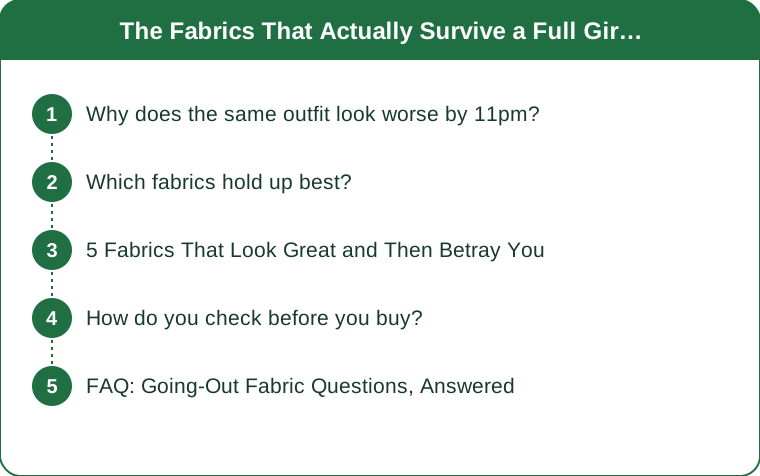
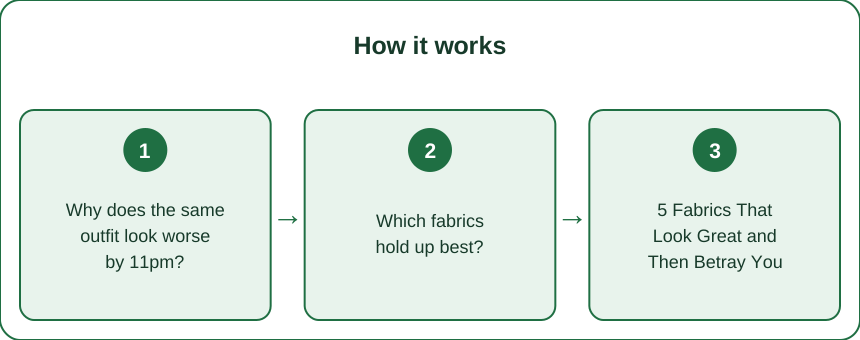
Why does the same outfit look worse by 11pm?
Three separate failures, each with a fabric cause.
Stretching out. Fabrics with poor recovery deform under sustained load and do not spring back. Sit for two hours in unlined rayon trousers and you get knee bags and a seat that has permanently lost shape. Recovery comes almost entirely from elastane content and knit structure — a 4 to 8 percent elastane blend recovers, a 100 percent viscose woven does not.
Wrinkling. Cellulose fibers — linen, rayon, viscose, cotton — crease easily because their molecular structure holds a new shape once bent under pressure. Synthetics and protein fibers like wool resist it. Wool is the underrated going-out fiber: a fine wool crepe looks the same at midnight as it did at seven.
Moisture visibility. This is the one people plan for least. A crowded venue is warm, and every fabric shows moisture differently. Flat, light-colored, smooth-faced fabrics — silk, satin, light cotton, pale rayon — show it dramatically. Textured, dark, or synthetic-blended fabrics hide it almost completely.
Most “this looked better in the mirror” moments are one of these three, and all three were decided at purchase.
Which fabrics hold up best?
Ranked by how reliably they get through a five-hour night.
Ponte knit. The most forgiving going-out fabric there is. A double-knit with meaningful elastane, it holds structure, resists wrinkles, does not show moisture, and recovers from sitting. Slightly warm, which is its only real drawback.
Thick jersey with 5 percent or more elastane. Drapes, recovers, hides. The thickness matters — thin jersey clings when damp and shows every line.
Crepe, especially wool or polyester crepe. The crimped yarn structure creates a textured surface that both resists wrinkling and diffuses light, so it does not show moisture. This is the workhorse of well-made going-out clothes.
Textured knits — ribbed, bouclé, cable, jacquard. Texture is functionally camouflage. Anything with surface variation hides creases and dampness that a flat weave would broadcast.
Matte polyester and poly blends. Not glamorous on the tag, genuinely excellent in practice. Wrinkle-resistant, colorfast, quick-drying. Choose matte over shiny.
Scuba and neoprene-adjacent knits. Structural, hold their shape all night, no wrinkles at all. Warm, so best for cooler months or cool venues.

5 Fabrics That Look Great and Then Betray You
1. 100 percent linen. Beautiful for an outdoor afternoon, wrecked within an hour of sitting in a booth. Linen creases at every fold point and does not release those creases while worn. If you love the look, choose a linen blend with at least 40 percent something else.
2. Rayon and viscose. These drape gorgeously on the hanger, which is exactly why they sell. They also wrinkle like linen, lose shape when warm and damp, and can develop permanent stretch at stress points. Viscose blended with elastane behaves considerably better than pure viscose.
3. Unlined light silk. Shows every temperature change on your body, wrinkles in the taxi, and water-spots permanently from a single splash. Silk works for a night out when it is heavy, dark, textured, or lined — a light pale charmeuse camisole is asking a lot.
4. Anything with a flat satin face. Satin is a weave, not a fiber, and its whole point is a smooth light-reflecting surface. That surface shows creases as bright lines and moisture as dark patches, and it does both under exactly the kind of directional lighting a venue has.
5. Stiff non-stretch woven cotton in a fitted cut. No give means it fits at rest and constrains everything else. It also creases hard across the lap and stays creased. Fine loose, difficult fitted.
The pattern: the failure mode is almost always flat surface plus no recovery. Add texture or add elastane and most of these become workable.
How do you check before you buy?
Four tests, thirty seconds, in the fitting room.
The fist test. Ball a section of the fabric in your hand, squeeze hard for ten seconds, release. If the creases stay, they will stay all night. If they fall out within a few seconds, the fabric recovers.
The stretch-and-release test. Pull a section firmly and let go. Does it snap back to its original dimension or stay slightly enlarged? Poor recovery here becomes knee bags and a stretched seat.
The sit test. Actually sit down in the fitting room for a full minute, then stand and look. This catches more problems than any amount of standing-mirror assessment, and almost nobody does it.
Read the tag. Look for elastane between 3 and 8 percent for fitted pieces, and be cautious of anything over about 70 percent viscose or rayon in a garment you intend to sit in for hours. Composition is on every garment sold and it is more predictive than the price.
One more, for the venue: hold the fabric under the fitting room light at an angle. Fabrics that flash under direct light will flash under venue lighting too, and often in photographs.
FAQ: Going-Out Fabric Questions, Answered
What is the single best all-rounder if I only buy one going-out piece?
A well-cut ponte or crepe piece in a dark color with a bit of texture. It handles temperature swings, sitting, dancing, and photographs, and it does not need special care.
How do I stop sweat showing without changing my whole wardrobe?
Color and texture do most of the work — mid-tones and busy textures hide moisture that black and white both, in different ways, reveal. Beyond that, a fitted breathable layer underneath moves moisture away from the outer fabric, which is why lined pieces outperform unlined ones.
Are natural fibers always better?
Not for this use case. Natural fibers win on breathability and feel, and lose badly on wrinkle recovery and moisture visibility. Wool is the exception that does both well. For a five-hour night in a warm venue, a good synthetic blend usually outperforms pure cotton or pure viscose.
TL;DR:
- Ponte, crepe, thick elastane jersey, textured knits and matte poly blends survive the night.
- Pure linen, rayon, viscose, light silk and flat satin do not.
- Three failure modes: stretching out, wrinkling, and showing moisture — all fiber-driven.
- Test in the fitting room: fist-crush, stretch-and-release, and actually sit for a minute.
- Texture and 3 to 8 percent elastane fix most problems before they start.
Hour five is the honest test of an outfit, and it is decided in the fitting room, not in the mirror at home.
Keep Reading
This article is for general informational and styling purposes only. Fit, sizing, and product availability may vary.